
Network Improvements on the UK Dover (DVR) Interface Consultation
Overview
Welcome to the NATS "Network Improvements on the UK Dover (DVR) Interface" consultation space.
From this page, you can explore the proposed changes, understand the expected benefits and impacts on the airspace, and share your views by responding to the consultation.
Each change is delivered through an Airspace Change Proposal (ACP), which follows the Civil Aviation Authority’s (CAA) CAP1616 process. This includes public consultation and regulatory approval, ensuring transparency and giving stakeholders a chance to have their say. For a complete history of all airspace change documentating to date, please refer to this ACP’s CAA Portal.
About this airspace change proposal
Only "Option 1: 3 COPs" (Coordination Points) was progressed from Stage 2. This consists of the removal of current KONAN and VABIK COPs and the introduction of three new COPs on the European boundary.
As the design progressed, four new COPs (OPFIM, MUCPI, BOLZE and STEVU) have been proposed, one COP (KONAN) retained, and two (RAPIX and VABIK) withdrawn. This has been designed in close collaboration with NATS’ neighbouring Air Navigation Service Providers (ANSPs).
MUCPI, BOLZE and STEVU are the three new COPs for traffic currently flight planning eastbound via KONAN or VABIK. For Maastricht’s separation purposes, RAPIX has been replaced with OPFIM, to be used by the same traffic as today. KONAN is being retained for as a Belgian / UK COP at skeyes’ request for airspace definition / containment purposes and will not be flight plannable as an exit point from UK airspace. Westbound traffic via KONAN, will be provided DCT from KONAN to the UK ATS network.
Other changes include associated changes to other waypoints and ATS routes, to align with new COPs; aircraft will be designated a COP based on their LTMA departure airport or previous routing within UK airspace, rather than their destination, as per today; speed restrictions are proposed for some LTMA traffic; and a SID truncation introduced for certain London Gatwick departures.
This proposal includes no change to controlled airspace boundaries or GA access, with RNAV 5 access being retained.
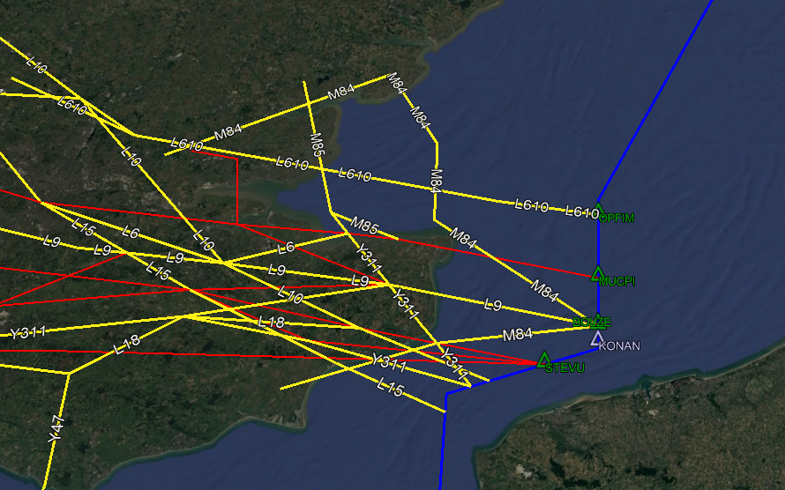
Initial assessments indicate potential enabled savings of approximately 200,784.0nm, 1,714.6 tonnes of fuel and 5,449.6 tonnes of CO₂ equivalent, compared to the Baseline “Do Nothing” in 2028. By 2037, these numbers have grown to 211,688.2, 1,809.7 and 5,751.9 respectively. Additionally, there is expected to be an improvement in airspace capacity and resilience, alongside a reduction in ATCO and pilot workload.
How to respond
This consultation will run from 00:01 on 1st October 2026 until 23:59 on 25th November 2026.
After reviewing the content below (links in the related document sections), please provide your feedback via the consultation response portal.
Why your views matter
This consultation is your opportunity to comment on the proposed changes. We want to ensure that anyone who could be affected – positively or negatively – is aware of the proposals and has the chance to provide feedback. Your responses to our consultation will help shape the final design.
Our engagement so far has focused on:
- Reaching out to impacted stakholders and giving everyone the opportunity to respond.
- Providing clear, detailed consultation materials to support informed responses.
- Ensuring the consultation period is appropriate.
We want to get your feedback on our proposed Option 1: 3 COPs.
Give Us Your Views
Published responses
View submitted responses where consent has been given to publish the response.
Share
Share on Twitter Share on Facebook